
Wenzhou, a city situated on China’s southeast coast, has long been geographically defined as “the end of the land and the beginning of the ocean”. Through a long historical evolution and extreme maritime climates, it has not only nurtured a profound regional culture but also forged a highly recognizable regional architectural paradigm among its fragmented coastline and scattered islands—the stone house.
The Construction Code: Wrestling with Storms and Granite
Here, the wildness of architecture stems from material authenticity. To withstand the super typhoons carrying storm surges and fierce winds every late summer and autumn, island ancestors sourced materials locally, transforming dense and hard granite into defensive walls for their living spaces. The artisanal “Tiger Skin Walls” utilize irregularly shaped granite blocks stacked together, achieving a delicate balance between gravity and crevices; the white lime pointing outlines rhythmic lines on the rough rock surface, echoing the undulating sea waves. This construction law of adapting to nature and wrestling with storms has become an excellent entry point for us to re-examine the contemporary philosophy of retreat.
Architectural Coexistence: A Brutalist Retreat Emerging from the Earth
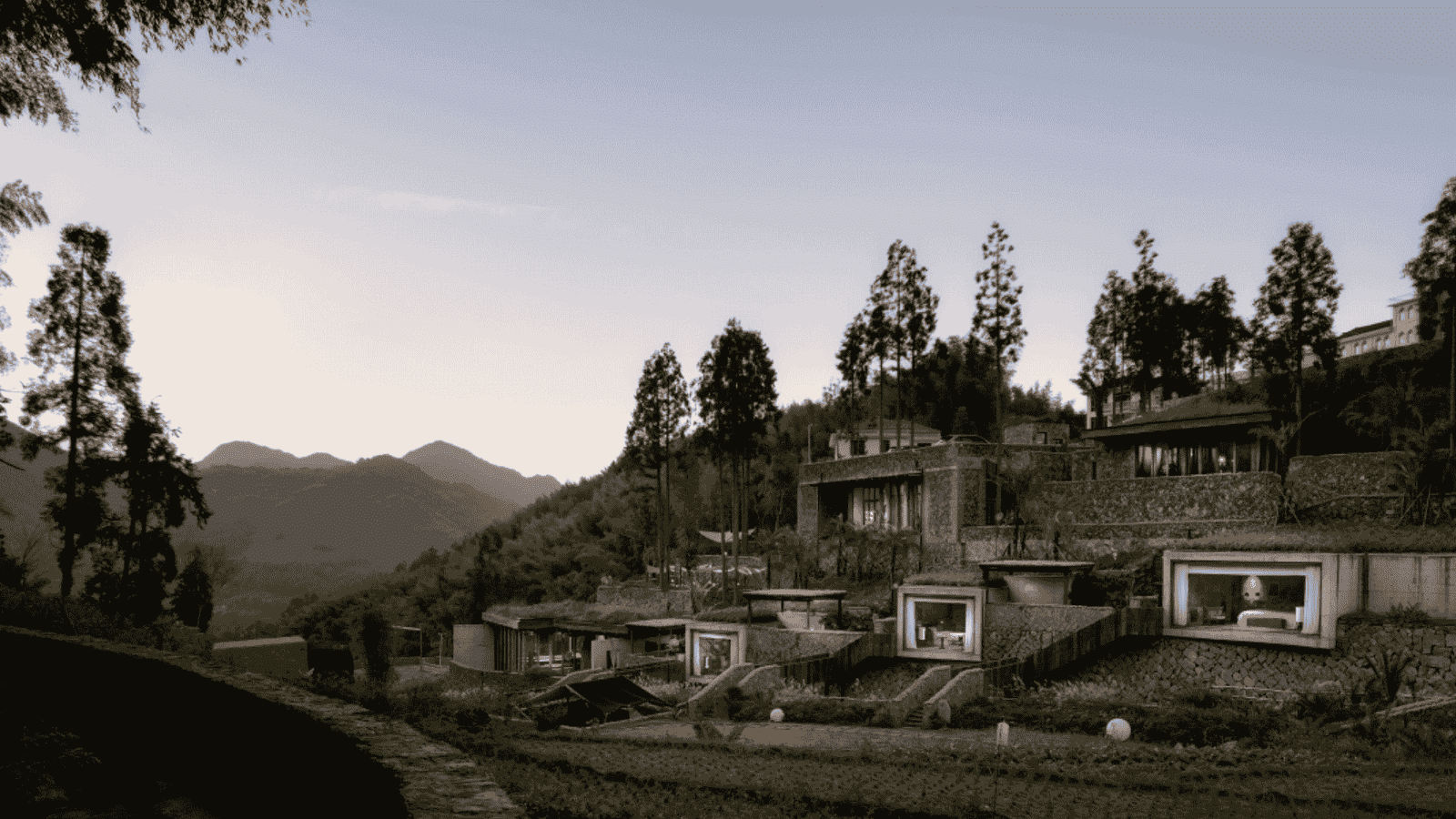
Nestled within the embrace of mountains and an ancient village, MUKRA Resort is the most affectionate contemporary response to this local wild aesthetic. Instead of arrogantly intervening in this ancient land, the hotel is built along a south-facing slope, constructed primarily with local rocks, and staggered to blend seamlessly with the mountains. The building presents a captivating brutalist style, even covered with earth, as if it were a natural growth breaking through the granite crevices. The village’s century-old stone houses stand like guardians of nature, and MUKRA, through modern design, pays homage to this traditional culture and ensures its continuation.
Spatial Narrative: The Giant Rock as Visual Focus and Sensual Skeleton
Stepping into MUKRA, you are enveloped by a strong primal force. Large floor-to-ceiling glass surrounds a massive natural rock, making it as eye-catching as a sculpture in a gallery and demonstrating a profound reverence for natural creations. This giant stone is not only the visual focus of the space but also the core structural support; crisscrossing old wooden beams cling to it, endowing the originally cold rock with spatial sensibility and poetry. In the guest room design, fair-faced concrete walls retain the building’s original skin and texture, while the clever application of botanical tones perfectly interprets the “color of nature”.
Textural Dwelling: Restrained Luxury and Long-Lost Silence
However, luxury is never about ostentation, but rather texture within restraint; wildness, too, absolutely does not mean roughness. In this sanctuary, rugged local rocks and recycled old wood collide and merge with delicate, soft linen bedding and refined mid-century furniture, creating a dwelling atmosphere that is both rustic and of high quality. Lightwells invite the valley’s sunlight and breeze into the interior; as the sun shifts throughout the day, the tone and perception of the space flow accordingly. On freezing winter days, guests can even sit around a bonfire in front of the giant stone, experiencing long-lost warmth and inner abundance amidst the dancing flames and the tranquil valley.
Epilogue: Rediscovering the Unhurried Rhythm of Nature
MUKRA Resort is not merely a place to rest; it is more like a miniature epic of Wenzhou’s rocks. It invites travelers from all over the world to detach from the clamor of modern cities, arrive at this intersection of mountain and sea, and rediscover the unhurried rhythm of coexistence with nature amidst the rough stone walls and the warm touch of vintage furniture.